以下為2015-2016學(xué)年人教版小學(xué)四年級(jí)英語(yǔ)上冊(cè)期末試卷(模擬試卷8)部分核心題型與內(nèi)容的翻譯參考,旨在幫助理解試卷結(jié)構(gòu)與題目要求。請(qǐng)注意,此翻譯為輔助學(xué)習(xí)之用,并非官方標(biāo)準(zhǔn)答案。
一、聽(tīng)力部分 (Listening Part)
1. 聽(tīng)音,選出你所聽(tīng)到的單詞。
Listen and choose the word you hear.
2. 聽(tīng)音,給圖片排序。
Listen and number the pictures.
3. 聽(tīng)音,選擇正確的應(yīng)答句。
Listen and choose the correct response.
4. 聽(tīng)對(duì)話,判斷句子正(T)誤(F)。
Listen to the dialogues and judge if the sentences are true (T) or false (F).
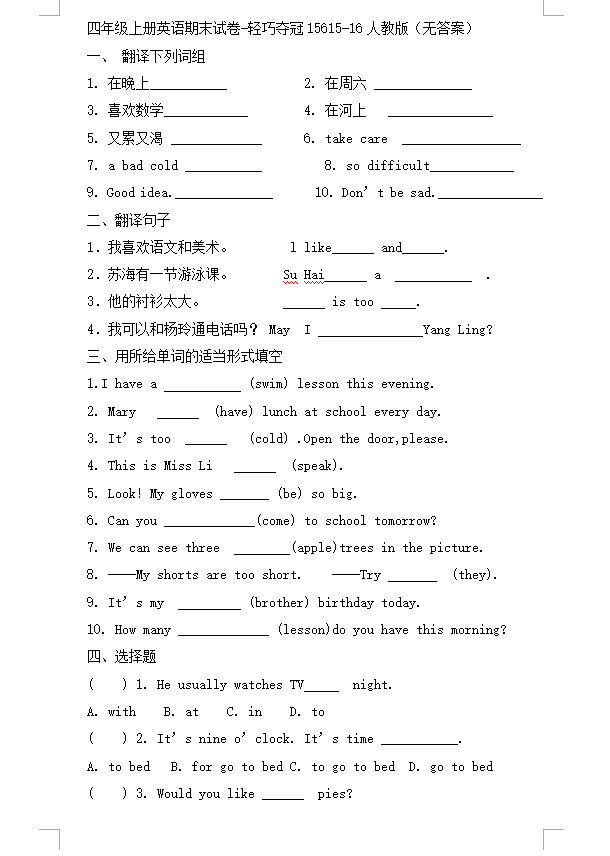
二、筆試部分 (Written Part)
A. 字母與詞匯 (Letters and Vocabulary)
1. 按字母表順序?qū)懗鏊o字母的前后鄰居。
Write the immediate predecessor and successor in the alphabet for the given letters.
2. 將單詞與對(duì)應(yīng)的圖片連線。
Match the words with the corresponding pictures.
3. 選出不同類(lèi)的一項(xiàng)。
Choose the word that does not belong to the same category.
B. 句型與對(duì)話 (Sentences and Dialogues)
1. 選擇最佳答案完成對(duì)話。
Choose the best answer to complete the dialogue.
2. 根據(jù)情景選擇正確的表達(dá)。
Choose the correct expression according to the situation.
- 例如:你想知道對(duì)方書(shū)包里有什么,你應(yīng)該問(wèn):
For example: If you want to know what's in the other person's schoolbag, you should ask:
- A. What's in your schoolbag?*
- B. Where is your schoolbag?*
C. 閱讀理解 (Reading Comprehension)
閱讀短文,判斷正(T)誤(F)或回答問(wèn)題。
Read the passage and judge true (T) or false (F) / answer the questions.
- 短文主題可能涉及:我的家庭、我的教室、我的朋友、一天的活動(dòng)等。
Possible passage topics: My family, My classroom, My friend, Daily activities, etc.
D. 寫(xiě)作 (Writing)
仿照例句,寫(xiě)一寫(xiě)你的書(shū)包里有什么。(至少寫(xiě)三樣物品)
Follow the example and write about what is in your schoolbag. (Write at least three items.)
- 例句:I have a new schoolbag. It's blue. In my schoolbag, I have an English book, a maths book and two storybooks.
Example: I have a new schoolbag. It's blue. In my schoolbag, I have an English book, a maths book and two storybooks.
試卷總體說(shuō)明:
本試卷旨在考查學(xué)生對(duì)四年級(jí)上冊(cè)所學(xué)字母、核心詞匯(如教室物品、家庭成員、職業(yè)、食物等)、基礎(chǔ)句型(如詢(xún)問(wèn)位置、物品歸屬、喜好、能力等)以及簡(jiǎn)單日常對(duì)話的掌握情況。聽(tīng)力部分著重于語(yǔ)音辨別和情景反應(yīng),筆試部分則綜合測(cè)試認(rèn)讀、理解和初步的書(shū)面表達(dá)能力。
給學(xué)生的學(xué)習(xí)建議:
復(fù)習(xí)時(shí)應(yīng)回歸課本,熟練掌握每個(gè)單元的Let's learn部分的單詞和Let's talk部分的對(duì)話。多做聽(tīng)說(shuō)練習(xí),并嘗試用學(xué)過(guò)的句型描述身邊的事物。